



Cold Room, Warm House? Here’s What’s Really Going On

February 27, 2026
Category: General,
There’s always that one room.
You know the one. The bedroom over the garage. The back office nobody uses in the summer. The guest room that somehow turns into a walk-in refrigerator every February.
You bump the thermostat up to 72. Then 74. Maybe 76. The living room feels fine. The kitchen is comfortable. But that one room?
Still cold.
At some point you start wondering if the thermostat has a personal grudge.
It doesn’t. But your HVAC system might be trying to tell you something.
Mid-Winter Is When Problems Show Up
February is when heating systems earn their paycheck. Long run times. Cold outdoor temps. Doors opening and closing. Wind pushing against the house.
And when the system is under that kind of load, small airflow or balance issues suddenly become obvious.
In mild weather, you might not notice. In February, you absolutely do.
Uneven temperatures are rarely about the thermostat itself. They’re almost always about airflow, duct design, or how your system distributes heat through the house.
Let’s break it down in plain language.
Your System Heats Air. It Doesn’t Magically Deliver It.
Think of your HVAC system like a delivery truck.
The furnace creates warm air. That’s the product.
The ductwork is the road system.
The vents are the delivery stops.
If the roads are narrow, blocked, leaking, or too long, the package doesn’t arrive the way it should.
Common Reasons Some Rooms Stay Cold
- Airflow Imbalance
Not all ducts are created equal. Some runs are longer. Some have more turns. Some serve multiple rooms.
The farther a room is from the furnace, the harder it can be to push warm air there. Especially in older homes where duct design wasn’t optimized for even distribution.
Upstairs rooms and rooms over garages are frequent trouble spots because they’re exposed to colder air and often have longer duct runs.
- Closed or Blocked Vents
This one’s simple, but we see it often.
A register gets closed “just for a while.” Furniture gets moved in front of a return. A rug covers a floor vent.
When airflow is restricted, pressure builds in other parts of the system. That can starve one room while overfeeding another.
It’s like trying to drink through a straw with your finger over the end.
- Duct Leaks
If ductwork runs through an attic or crawlspace, small gaps or loose connections can leak warm air before it ever reaches the room.
In winter, that means your heat may be warming the attic instead of your bedroom.
That’s not the goal.
- Poor Insulation
Some rooms simply lose heat faster.
Rooms over garages, bonus rooms, or additions often have less insulation. So even if warm air is delivered properly, it escapes faster than the system can replace it.
Your heater might be doing its job. The room just can’t hold onto the heat.
- System Sizing or Design Issues
If the system was sized incorrectly when installed, or if the home was remodeled without adjusting the ductwork, airflow can become uneven.
Adding square footage without upgrading distribution is like adding lanes to a highway but keeping the same off-ramp.
Eventually, traffic backs up.
Why Turning Up the Thermostat Doesn’t Fix It
When one room is cold, the instinct is to raise the temperature.
The problem is, your thermostat likely sits in a central location. When that area reaches the set temperature, the system shuts off.
Meanwhile, the colder room never quite catches up.
So you end up overheating the comfortable areas trying to rescue the cold one.
It’s frustrating. And expensive.
Safe Things You Can Check
There are a few simple things homeowners can safely look at:
Make sure all supply and return vents are open and unobstructed.
Check your air filter. A clogged filter reduces airflow across the entire system.
Keep doors open between rooms to allow better air circulation.
If those steps don’t solve it, the issue usually runs deeper than surface adjustments.
This Is Where a Professional Evaluation Matters
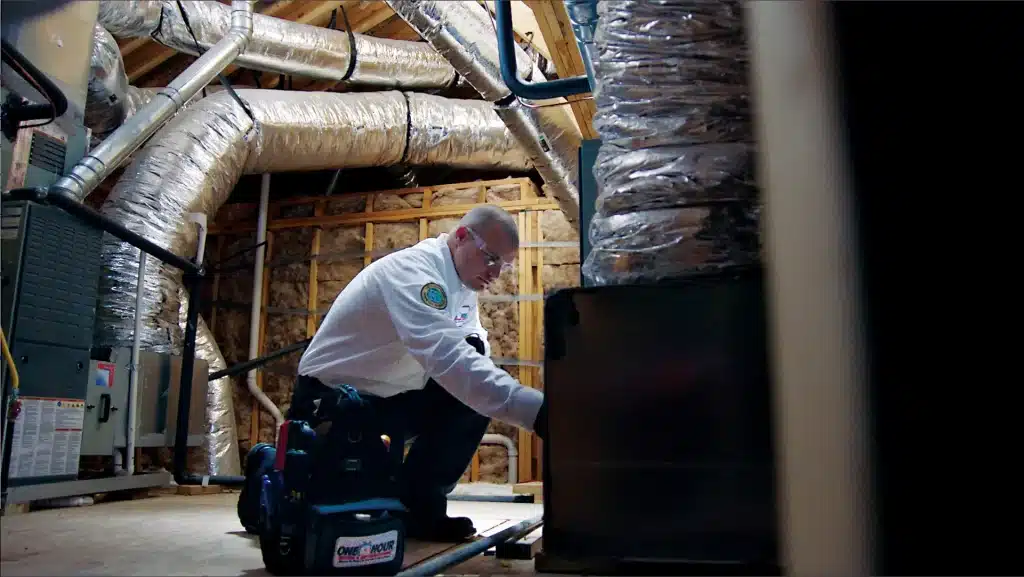
Uneven temperatures are rarely solved by guesswork.
A proper system evaluation looks at:
Airflow measurement
Duct design and integrity
Insulation factors
System performance under load
The goal isn’t just to “make it warmer.” It’s to balance the system so your entire home feels consistent.
At One Hour Heating & Air Conditioning, we don’t guess. We measure. We document. We show you what’s happening inside your system so you can see it for yourself.
That’s how comfort gets fixed the right way.
February Is the Perfect Time to Address It
If a room is cold now, it will be hot in July. Airflow problems don’t take seasons off. They just show up differently.
Correcting balance issues during winter prevents summer complaints later.
And it makes your home feel the way it should have felt all along.
No sweaters in the guest room.
No space heaters humming in the corner.
No thermostat battles.
Just steady, even comfort.
If you’ve got a room that never seems to cooperate, let’s take a look. Our team will arrive on time, respect your home, and give you straight answers about what’s happening and how to fix it.
Because your thermostat shouldn’t have to work overtime to win an argument with one stubborn room.